
Social Day at ASB
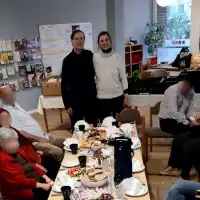
Our target groups include recipients of citizen’s allowance and pensioners, as well as single parents and women with limited financial means. Our cooperation partners are Haus der Familie, HausDrei, ASB and Flaks, from whom we primarily receive our clientele.
Children also visit us. They paint and play or even help with the raffle that determines the order of distribution. There is always a table available for them where they can draw, do puzzles, and play. We make sure that children are especially protected. Here, children are allowed to be free – which also means they are allowed to be loud.
Everyone must feel safe. Therefore, we always ask everyone to treat each other in a friendly and respectful manner, using considerate language, being mindful of one another, and behaving calmly and thoughtfully.
Anyone is welcome to help. The focus is on the joy of the shared experience. Achieving a perfectly equal distribution is rarely possible, but each time we try to distribute the rescued food as fairly, justly, and evenly as we can. After all, everything is a gift. We accompany the entire process in a spirit of friendship: friends for friends.
Procedure
For our project, we set up the tables. We arrange one table for a shared breakfast and seating, and a second one for the goods to be distributed.
Next to the breakfast table, we create a separate area for children to draw, do crafts, or puzzles.
The goods table is arranged parallel to the central aisle. The tables may be placed with a small gap between them so that several crates can fit. Our plastic tablecloth is spread out on the goods table.
Together, we take the crates and goods from the bicycles and lay them out on the table covered with the plastic tablecloth. If the table is already full, other surfaces can be used.
Please be careful. The crates are sometimes very full and extremely heavy. It is best to carry them in pairs. And please always pay attention to your back. Everyone should stay healthy.
Before sorting begins, it is advisable to set up garbage bags. We need three: one for plastic, one for paper and cardboard, and one for leftovers.
Now we have tasks that can be done simultaneously: sorting the goods and preparing the food for the breakfast table. Anyone who would like to help is warmly invited to do so.
Preparing Breakfast
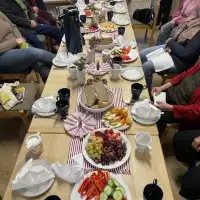
We are allowed to use dishes from the kitchen and the coffee machine. From the donated goods, we now create a small buffet with food and drinks. However, only authorized persons may stay in the kitchen.
Some set the table while others cut fruit. Often, a beautiful scene emerges once everything is arranged. Then we take a photo before opening the buffet. We make sure that no faces are photographed, only the food. Our space should remain protected for everyone.
Sorting the Goods
When collected, the goods are often mixed together. Now apples should be placed with apples, peppers with peppers, and the small potatoes found under the cabbage, and so on.
We have sixteen plastic vegetable crates available for sorting.
While sorting, we pay attention to the quality of the goods. Moldy parts must be removed immediately. Items with heavy bruising are brought to the kitchen, where they can be used for the breakfast table.
We provide small household scissors. Packaging can be opened and separated into plastic and paper and disposed of in the respective garbage bags. If there is a large quantity of one type, the goods may remain packaged. During distribution, each visitor will receive one package.
For sorting baked goods, we first line the crates with baking paper and put on latex gloves.
Preparing the Distribution
For the assortment, we have prepared labeled cardboard cards with images on which the counted or estimated quantities are noted. These are placed one by one next to the corresponding goods.
For distribution, it is wise to arrange the available goods neatly. Heavy items are placed on the left, light and delicate ones on the right. In addition, “either-or” crates are set up. These contain goods that we do not have in sufficient quantity and therefore offer as a choice. “Either-or” crates should be thematically consistent whenever possible – fruit with fruit, salad with salad.
To determine the order, we have distributed cards, usually from quartets featuring animals or ships. We have two identical decks. From one deck, each visitor draws a card, similar to a number. From the other deck, we draw lots to determine the order. This is necessary because we cannot always monitor who arrived when. To maintain a certain fairness over time, we distribute the cards at intervals.
Based on the number of cards, we can now see how many people will receive something. We also estimate how many late arrivals might join us and now have a total count.
Next comes laying out the quantity signs.
Using the formula
we calculate how much each person may take of each item.
During this process, we check whether we need to rearrange anything to create good “either-or” combinations.
Distribution
After the morning welcome and a short address, the actual distribution begins.
The individual decks of cards are now shuffled separately, and a person who is as neutral as possible draws a card. The person holding the matching card is now called and may come to the goods table to take fruit and vegetables according to the calculated quantities. The moderator assists with selection and packing the items into bags.
We kindly ask everyone to bring their own bags, egg cartons, and trolleys.
For goods that are divided into equal quantities anyway, the order does not matter. However, for the “either-or” crates, those drawn first naturally have an advantage in choosing.
After the Distribution
Once all cards have been drawn and everyone has received something, we slowly come to an end.
We return the dishes to the kitchen and place them in the dishwasher. Everything is left clean so that the next group finds a well-kept space.
The remaining items that result from division remainders or because someone did not want to take something are collected in one crate.
At the end, sometimes a senior citizens’ kitchen comes and takes some fruit and vegetables for elderly people in need who can no longer leave their homes.
Sometimes there are also additional late arrivals. We can provide them with the remaining items.
Crates that are empty again are cleared of leftovers, stems, leaves, and juice stains, cleaned hygienically, and then stacked back into the cargo bike.
Finally, we clean the tables with a hand brush and wipe them down thoroughly. The tablecloth is also wiped, dried, and folded again.
The floor is swept clean, and the tables and chairs are returned to their original positions. The accumulated waste is disposed of in separated bins.
Bags that belong to us are placed back into the bicycles.
That’s it.
On 22.11.25, we had the honor of being supported by employees of the company AdEx Partners during a “Social Day” at our distribution.
Once again, a big thank you for your help!
Some members of our team* were prepared for this day and kindly and successfully guided the visitors through the tasks described above.
(*Our participants regularly and actively support us in carrying out the tasks instead of passively just receiving the goods. In doing so, they practice language skills as well as joint decision-making and action.)
We were also delighted to receive a generous donation from a consumer goods manufacturer. On that day, our offer therefore included not only food but also personal care products.
If you would like to support our project with a donation, please feel free to contact us or donate via our donation account. Only through donations can we continue this charitable work. Thank you very much!